New Proposal for Toxicity Equivalent Factors
A Comparison
- 2025-09-01
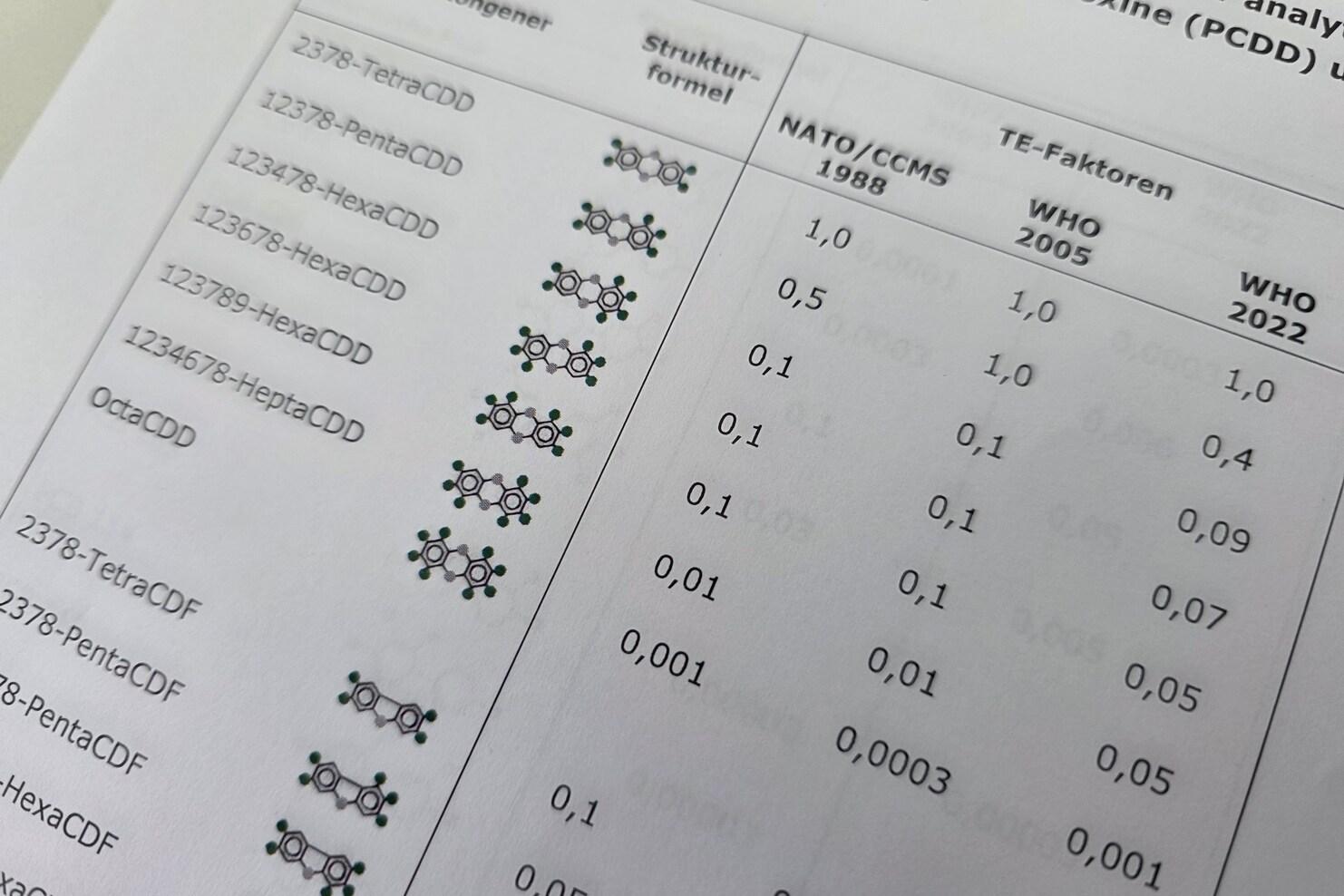
Some familiar names appear in the publication by Michael DeVito et al. (Regulatory Toxicology and Pharmacology 146 (2024)), which highlights the WHO's (2022) reassessment of TE factors for dioxins and PCBs.
These currently have no regulatory impact on the assessment of dioxin/PCB levels in different matrices. Nevertheless, we have conducted a test comparison of the levels of some matrix groups (expressed in toxicity equivalents [TEQ]) according to the currently valid calculation method according to WHO 2005 compared to the proposed WHO 2022.
Even though the data set used for this purpose was small, some trends are emerging, with careful interpretation:
- gases. Since the combustion profiles of dioxins and PCBs generally follow a similar pattern, the calculations also show a comparatively low range of variation, which leads to lower TEQs for dioxins in the WHO 2022 assessment than in the WHO 2005 assessment (approx. 20% lower). For PCBs, the WHO (2022) TEQ is on average 50% below the WHO (2005) TEQ.
- Residues. Here, the range of variation is much greater and, of course, strongly dependent on the origin of the samples. However, we would tend to assume that the assessment according to the 2022 TEFs will be higher on average than that of the current TEFs.
- Food/feed. Here, too, we are of course considering a large number of sample types from different sources. Accordingly, the range of variation is also enormous. Nevertheless, based on our research, we would expect a lower assessment by the WHO in 2022.
The future will tell whether these assessments are accurate. The attached file shows a comparison of the two TEF models.
